Alright folks, it’s 2026. We’ve avoided it long enough. It’s time to have a conversation – a real conversation – about what constitutes a “spoiler” in this country.
I’m not sure when we went off the rails as a society, but I don’t seem to know a single person who can wholeheartedly protect the narrative integrity of any media they consume anymore. It’s horrific, and I don’t want to keep losing friends.
I’ve had all sorts of media ruined or spoiled in some way: movies, TV shows, video games, porn videos.
You’d think that the generation that invented the term “Spoiler Alert” would be especially cognizant about what it means to reveal key plot elements, but we’ve just been too conditioned to share our opinions about whatever is cycling through the zeitgeist.

Now, before I go on, I want to make it clear that this is not about spoilers we find online. As far as I’m concerned, if you are searching for content about a show or movie you have not watched, and stumble upon a spoiler, that’s on you.
We are no longer in the nascent stages of the internet; you should know by now that the internet has no respect for your schedule or viewing habits.
There is only one way to go about your life if you intend on watching a movie, playing a game, or binging a TV show in the 21st century; you absolutely avoid any content about it until you’ve consumed it.
Trailers exist for people who are not aware that a movie is coming out or for people on the fence about going to see the movie in the first place. That’s why they basically show the entire plot, because that approach of revealing most of the important beats of a film performs well in focus groups. And do you know anyone cool who has ever been part of a focus group? Exactly.

If you know you’re going to watch something, why even bother watching a trailer? For the hype? Grow up.
We all know Dune: Part 3 is going to be awesome, just delay that gratification a little bit.
There’s a whole other conversation in here about how overly long and spoiler-y modern trailers tend to be, but this is not the point of this essay.
No, my dear reader, this is not about the media ecosystem. This is about you, and me, and this fragile little society we all share. This is about the conversations we have with our friends and family, and about how withholding information about media is one of the purest expressions of love.
This is about how controlling our excitement to preserve another person’s experience is a simple act of profound kindness. This is to ensure that the first time someone consumes a piece of media, they do so as intended; in an unadulterated experience vacuum where their first exposure to a movie, show, or game is truly virginal.

This is about demonstrating the bare minimum human decency in a world governed by chaos. This is about separating ourselves from animals living on pure impulse. This is about civilization.
Even when we don’t intend to spoil something, we end up doing it anyway.
Prime example: Have you ever told someone to watch a movie – let’s say a suspenseful one – and in the process of selling them on why they should watch it, you mention that it has a great ‘twist’ in it? I don’t mean to be a pedantic bitch about it, but that’s a fucking spoiler.
Telling someone that they can expect a narrative twist in a story primes them for the fact that there is one in the first place. They’re looking for it. And here’s the thing about twists: they hinge on the fact that YOU DON’T SEE THEM COMING.
I don’t want to beat it to death, but I’ve been in more than one argument with friends about this. So to make my point, here is a definition put together by Gemini:
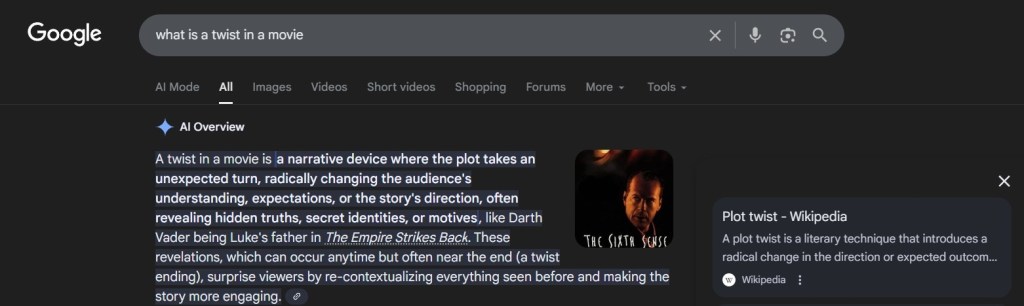
“A twist in a movie is a narrative device where the plot takes an unexpected turn, radically changing the audience’s understanding, expectations, or the story’s direction, often revealing hidden truths, secret identities, or motives, like Darth Vader being Luke’s father in The Empire Strikes Back. These revelations, which can occur anytime but often near the end (a twist ending), surprise viewers by re-contextualizing everything seen before and making the story more engaging.”
The fucked up thing about this definition is that there’s a spoiler in it. If you’ve never seen The Empire Strikes Back (which like, wtf, lol, how?), I’m sorry. But as I said earlier, this is not about the internet, so I consider this piece exempt.
In telling someone there is a twist in a movie, you have robbed that movie of at least some of its narrative power and robbed that person of a better experience.
And that’s just one example!
I’m not a policy expert, but I think the problem starts with our school system. Too much money is being spent teaching kids useless skills like calculus and grammar – seriously, isn’t that what ChatGPT is for?
Instead, we should be focusing on things that are actually helpful, like personal finance, critical thinking, and not telling people that they’ll “never see the twist coming.” Because, you duffus, now they will.
But it’s easy to point fingers without doing anything about it, and I’ve chosen to do something about it. This is my contribution to our collapsing society. What are you doing to make the world a better place?
I’ve realized that the first major issue we have is that we do not share a definition. So, let’s define some terms.
What does it mean to spoil something?
A “spoiler” is any information that reveals a key plot element of a piece of media. That includes information that may not necessarily be a direct plot revelation, but is enough for someone to infer a plot point.
We need to agree on this. Especially that second sentence. Because a spoiler is more than just plainly stating what happened in a movie. Let’s give ourselves more credit, we are not children here. If you think that the only way you can spoil something is to yell out, “You find out he’s been dead the whole time at the end!” you might need to be sterilized.
I’m not the smartest guy in most rooms I’m in. Hell, I’m rarely the smartest utensil in the rooms I’m in, but even I’ve been able to put together entire plots of movies in my head just because someone has told me the themes a film explores.

I don’t know who you hang out with, but I try not to hang out with too many dumb people (sorry Billy). Most of my social circle has enough sense to imagine how a movie can play out if I give them an idea of the tropes they’ll come across.
This can be a conversational minefield if you’ve gone most of your life naively spoiling movies and TV shows for your friends. Don’t worry, it’s not your fault. Your intentions were good, and you are just the result of the environment you were raised in. But at some point, we need to stop blaming our parents for the traumas they caused, and we need to start taking accountability for our own actions.
With that in mind, here is a quick list of things that should be considered a spoiler, but you have been talking about for way too long:
- Telling someone about the themes of a movie under certain circumstances can be a spoiler.
- Telling someone the movie gets really good after the first 30 minutes.
- Telling someone literally anything about the ending of a movie, show, or game is a spoiler.
- Talking about how they should pay attention to the background details because they become really important.
- Telling someone that everything changes after the 4th episode.
- Telling someone that the movie is not about what they think it’s about.
- Telling someone you had to pause, walk away, or take a breath after a certain scene because it was too intense.
- Telling someone to keep an eye out for a certain character.
- “That’s all I’ll say about them” – Like, come on, now we know there’s more.
- Saying that it’s similar to another show or movie, especially if the comparison has a characteristic narrative arc.
- “It’s a genre bender!”
- Talking about how the plot subverts expectations for the genre.
- “It’s darker than it seems in the trailer.”
- Telling someone to text you after a certain episode.
- Making a facial expression after a character is mentioned, therefore making it clear that something happens with, to, or because of them.
I know what you’re thinking: But Lando, how do I tell someone to watch something without giving too much information about it?
Was that what you were thinking? Oh god, I hope so, otherwise this is just presumptuous and not clever at all.
Anyway, there are two simple ways to encourage someone to consume something you’re excited about:
- Simply tell them it’s good and trust you on it.
If you’ve built enough good will and a reputation for having quality recommendations, that should be enough. Know your audience. If you and your friends have similar tastes, it should suffice to tell them, “Just trust me on this, go in blind, and it’ll be better that way.”
Say, for instance, that you have not built that good will and don’t have a reputation for quality recommendations. Well, then you no longer get to recommend anything anymore.
Recommendations are a societal privilege, not a right, and you have wasted enough people’s time with your trash suggestions. Now all you get to do is wait for someone to ask for your opinion so you can tell them you don’t have one and then go back to watching NCIS.
- Talk about why you liked it, not what happened.
If you watched or played something with a well-constructed narrative and interesting characters, why not just say that? We can avoid those conversational signposts like “It gets really dark” or “You won’t see the ending coming” and replace them with “It kept me engaged through the end” or “The story felt intentional and thoughtful.”
Your goal in recommending something is to share an experience. What a beautiful thing that is; to watch something and think, “Hey! I enjoyed this, and I want the people in my life to experience this same enjoyment.” It’s a precious and generous instinct that can be partially undermined by your complete lack of self-awareness.
Here are some parting thoughts.
I believe there are two things every adult should be federally mandated to do: 1) Take LSD once in their lives, and 2) Watch the Dune movies. Preferably at the same time.
You can’t spoil an acid trip, but you sure as shit can spoil Dune. And as an example to model your future conversations about movies and TV shows, here’s how I would encourage someone to watch the movie without spoiling the story:
It’s Star Wars for adults. Go watch it and thank me later.
 Lando Writes Sometimes